

Ship maintenance isn’t just necessary for running the business; it’s also one of the best ways for a shipping company to cut costs. The link between maintenance standards and operating expenses is measurable at every point in the vessel’s commercial life: in fuel consumption, repair frequency, unplanned downtime, and the serviceable life of the equipment that keeps the vessel fit for purpose. For fleet operators and vessel owners managing cost pressures across multiple voyages, understanding how maintenance decisions translate into operating cost outcomes is as important as understanding the technical requirements themselves.
Key Takeaways
- Preventive vessel maintenance consistently costs less than corrective repairs when you include the full cost of disruption, cargo delays, port fees, and charter penalties alongside the direct repair bill.
- Engine and propulsion maintenance directly affects fuel consumption: a poorly maintained main engine, fouled hull, or worn propeller each contribute measurably to higher fuel costs per voyage.
- Unplanned downtime is the single most expensive consequence of deferred maintenance, with the indirect costs of a vessel stoppage often exceeding the direct repair cost many times over.
- Regular underwater maintenance, like cleaning the hull, polishing the propellers, and managing fouling, gives some of the best returns on maintenance investment because it directly cuts down on fuel use.
- A structured planned maintenance system aligned with manufacturer schedules and classification society requirements reduces the frequency and severity of survey findings, keeping the vessel commercially available without unplanned operational interruptions.
How Vessel Maintenance Reduces Operating Costs: The Core Connection
The relationship between maintenance standards and operating cost runs in both directions. Good maintenance reduces vessel operating costs by preventing failures, improving efficiency, and extending equipment life. Poor maintenance slowly raises operating costs, often without being noticed until something breaks down at the worst possible time for business.
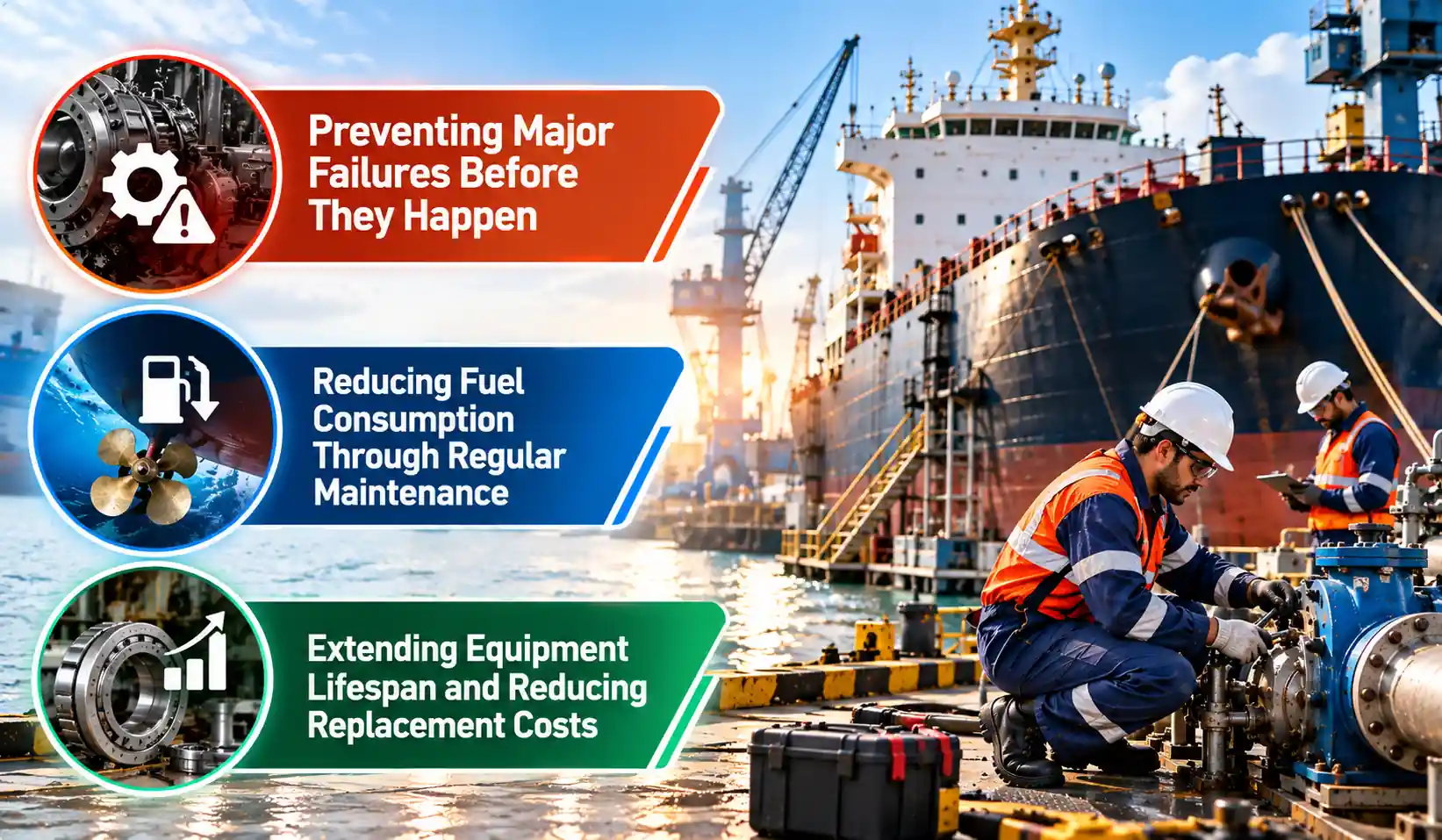
Preventing Major Failures Before They Happen
The cost of a corrective repair is never limited to the parts and labour required to fix the failed component. When a vessel suffers an unplanned breakdown, direct repair costs sit alongside port fees during the stoppage, potential cargo claim exposure, crew costs for additional time in port, and any charter penalty or freight loss that flows from the delay. In most cases, the total cost of an unplanned stoppage significantly exceeds what a scheduled preventive repair would have cost at the same point in the maintenance cycle. Ship Repair Services in India conducted as planned maintenance work rather than emergency response are more cost-controlled, better prepared for parts availability, and completed more quickly because the repair scope is known in advance rather than diagnosed under pressure.
Reducing Fuel Consumption Through Regular Maintenance
Fuel is the largest single operating cost for most commercial vessels, and maintenance standards directly and measurably affect fuel efficiency. A main engine running outside its optimum operating parameters because of deferred service work consumes more fuel per unit of output. A propeller with surface roughness from corrosion or minor damage increases shaft load and reduces propulsive efficiency. A hull carrying fouling growth increases drag progressively between cleaning cycles. Each of these factors operates independently, but their combined effect on fuel consumption across a voyage or a trading season can be significant. Ship maintenance services that address engine condition, propeller surface finish, and hull cleanliness as part of a planned maintenance cycle reduce fuel cost per voyage in ways that accumulate meaningfully over time.
Extending Equipment Lifespan and Reducing Replacement Costs
Regular maintenance extends the serviceable life of marine machinery and shipboard equipment in ways that deferred maintenance directly shortens. Corrosion managed as part of a scheduled maintenance programme remains a surface condition; ignored corrosion progresses into structural degradation that requires far more expensive intervention or outright replacement. Bearings, seals, and running components inspected and serviced on schedule fail at predictable intervals; components run until failure do so at unpredictable moments, often taking related components with them. The capital cost of replacing major marine equipment is always higher than the accumulated maintenance cost of keeping it in service, and for vessels with useful lives measured in decades, the difference compounds significantly over the operating period.
Which Areas of Vessel Maintenance Have the Biggest Cost Impact?
Not all maintenance work delivers equal cost returns. The following three areas consistently produce the largest impact on operating cost and are the priority focus of any planned maintenance programme.
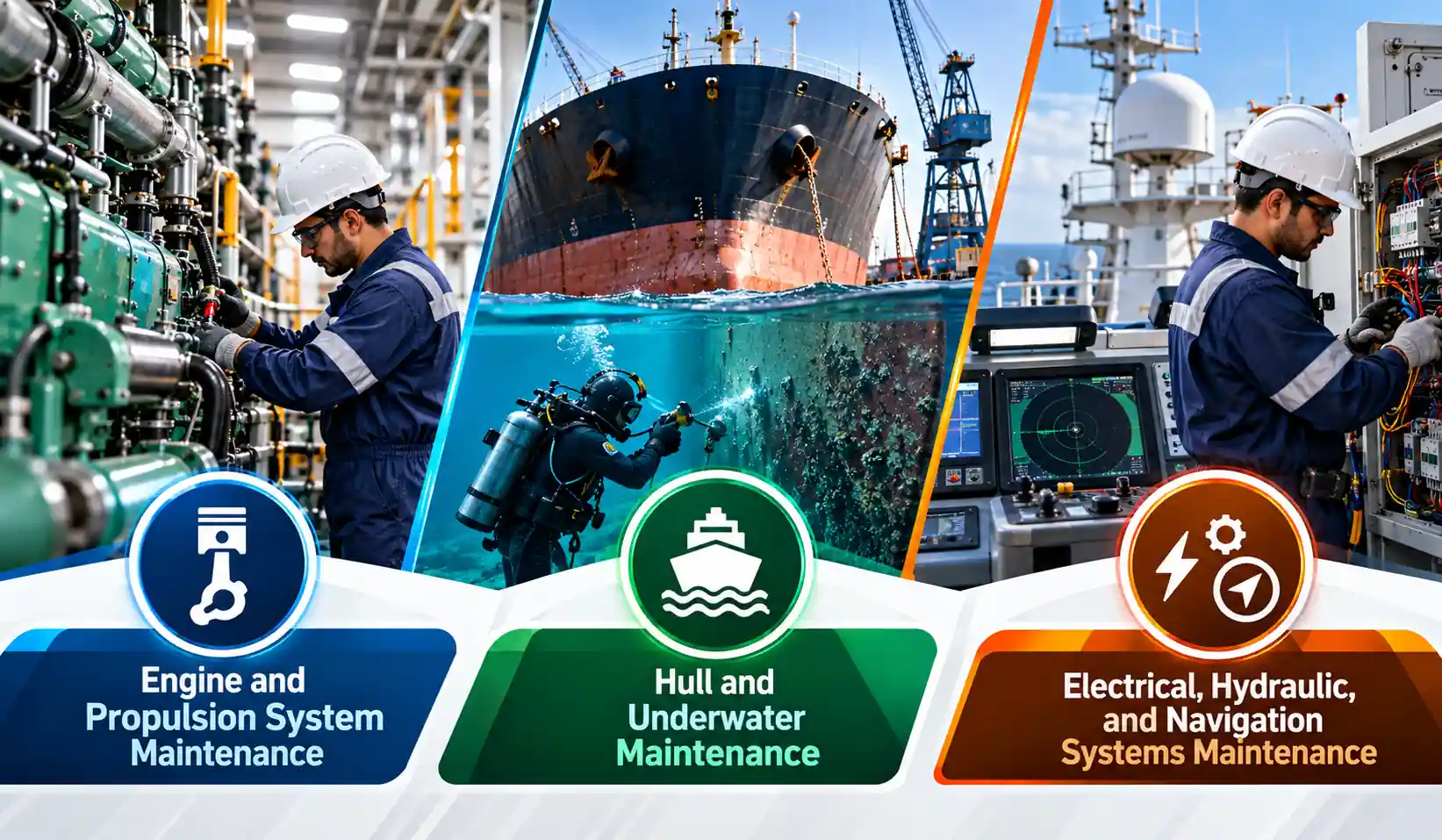
Engine and Propulsion System Maintenance
The main engine and propulsion system are the highest fuel consumers on any commercial vessel and the components whose failure carries the most severe operational consequences. Regular main engine maintenance checks the condition of the fuel injection systems, the turbocharger, the wear on the cylinder liners, and the performance of the exhaust valves. This keeps the engine running as efficiently as designed. Auxiliary engine maintenance ensures the vessel’s electrical and hydraulic systems remain reliable between main engine operations. Propulsion shaft alignment and stern tube condition affect both fuel efficiency and the risk of catastrophic propulsion failure at sea. A well-maintained propulsion train is quieter, more efficient, and more predictable than one operating with deferred service work across multiple components.
Hull and Underwater Maintenance
Hull and underwater maintenance delivers some of the clearest returns in the vessel maintenance programme.
Fouling growth increases hull resistance and fuel consumption at a rate that depends on trading routes, water temperatures, and time since the last application. Propeller polishing between dry docking cycles removes surface roughness and growth that reduces propulsive efficiency and increases cavitation risk. In many cases, underwater inspection and repair of hull damage, anodes, and through-hull fittings can be carried out afloat, avoiding the cost and scheduling disruption of unplanned dry docking. Underwater Ship Repairs conducted by trained divers during port calls address hull condition between dry docking cycles and extend the interval over which the vessel can trade commercially without a full haul-out.
Electrical, Hydraulic, and Navigation Systems
Electrical systems, hydraulic equipment, and navigation instruments degrade through a combination of corrosion, moisture ingress, mechanical wear, and vibration. Failures in these systems carry costs that extend well beyond the component itself: a navigation equipment failure has safety implications that can result in port state control detention; a hydraulic system failure on cargo handling equipment delays cargo operations and incurs port and terminal costs during the repair period; electrical failures in critical circuits require emergency attention regardless of where the vessel is or what it has scheduled.
Regular inspection and testing of these systems identifies deterioration before it becomes failure, and the repair cost at the inspection stage is almost always lower than the combined repair and delay cost of a failure under operational conditions. Ship Repair Services covering electrical, hydraulic, and navigation systems as part of a planned maintenance schedule keep these systems within the performance parameters required by both classification surveys and commercial operations.
Final Thoughts
Vessel maintenance is the most consistent lever shipping companies have to manage operating costs over the long term. Prevention is always cheaper than repair, and planned repair is always cheaper than unplanned failure. Across engine performance, fuel efficiency, hull condition, and equipment reliability, a well-managed maintenance programme delivers a vessel that costs less to operate, earns more through commercial availability, and retains its value over a longer trading life. Aasutosh Marine supports vessel operators across major Indian ports with ship repair, underwater maintenance, and planned service work delivered by qualified teams to standards that meet classification requirements and commercial performance demands.
Frequently Asked Questions
How does vessel maintenance reduce operating costs?
Vessel maintenance reduces operating costs through four connected mechanisms. It prevents costly unplanned failures that carry disruption and delay costs far exceeding the repair itself; it keeps engines, propellers, and hull surfaces operating at designed efficiency, reducing fuel consumption.
Why is preventive maintenance important for ships?
Preventive vessel maintenance is important because commercial vessels operate in an environment that accelerates deterioration across every mechanical, electrical, and structural system on board.
Can vessel maintenance reduce fuel consumption?
Vessel maintenance affecting fuel consumption includes main engine servicing, which keeps the engine operating at its design efficiency; propeller maintenance and polishing, which reduces shaft load and cavitation; and hull cleaning, which removes fouling growth that increases drag.
How does regular maintenance prevent costly ship repairs?
Regular ship maintenance prevents costly repairs by identifying and addressing deterioration before it progresses to failure. Bearing wear identified during an inspection is addressed at the cost of the bearing and the labour to replace it.
What equipment requires regular vessel maintenance?
All critical vessel machinery and systems require regular maintenance, with the frequency determined by manufacturer schedules, classification society requirements, and the vessel’s trading pattern.