

Aranca released an industry report in July 2025 called India’s Ports: New Engines of Global Trade. It says that these ports handle almost 95% of the country’s international trade by volume. One facility in that network stands out from the rest: Mundra Port. In FY 2024-25, it handled more than 200 million metric tonnes of cargo, making it India’s first port to do so and, by a large margin, its largest commercial port.
This blog breaks down what actually makes Mundra Port India largest commercial port, the infrastructure behind that scale, and what it means for vessels and cargo owners who depend on it.
Key Takeaways
- Mundra Port handled over 200 million tonnes of cargo in FY 2024-25, making it India’s first port to cross that threshold and its largest by volume.
- Indian ports move ~95% of the country’s trade by volume, and Mundra alone accounts for a significant share of that traffic.
- A Rs. 45,000 crore expansion is underway, targeting a jump from roughly 250 MMTPA of capacity today to 514 MMTPA by 2030.
- Under one set of rules, Mundra takes care of all the main types of cargo, including containers, dry bulk, liquid and crude, and specialised cargo.
- Cargo owners and shipping lines choose Mundra over other Indian ports because it is connected by road, rail, and coastal shipping.
- Reliable marine support services, including ship chandling, repairs, and safety equipment servicing, are what keep vessel turnaround at Mundra fast and predictable.
Where Is Mundra Port Located?
Mundra Port sits on the Gulf of Kutch in Gujarat, India, and is operated by Adani Ports and Special Economic Zone (APSEZ). Its location gives it direct access to major East-West global shipping routes connecting Europe, the Middle East, and Asia, without the detours many other Indian ports require. That geographic advantage, combined with a naturally deep draft, is one of the first reasons Mundra Port became a preferred call for large vessels.
Because vessels calling at Mundra often arrive on tight schedules, having a Ship Chandler in Mundra Port on hand for provisions, repairs, and compliance support is as important to a smooth port call as the port’s own infrastructure.
What Makes Mundra Port India’s Largest Commercial Port?
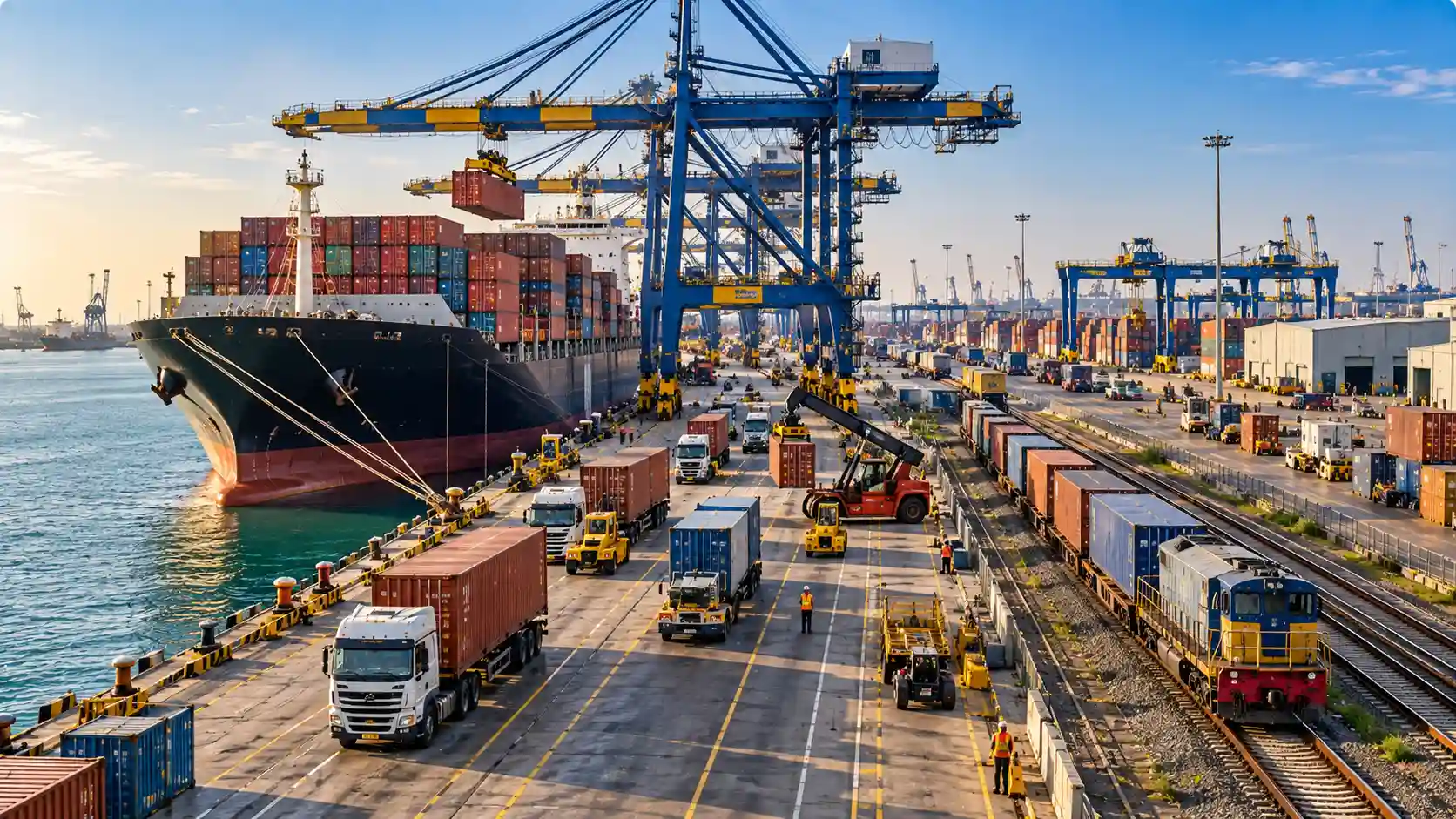
A few factors combine to make Mundra Port India’s largest commercial port, rather than any single one:
- Cargo volume: Mundra handled over 200 million metric tonnes in FY 2024-25, the highest of any Indian port
- Deep-draft berths: Capable of receiving some of the largest cargo vessels calling at Indian ports, including capesize bulk carriers and ultra-large container ships
- All-cargo capability: Few Indian ports handle containers, dry bulk, liquid, and crude cargo at the same scale under one port authority
- Private port efficiency: As a private port in India, Mundra has been able to invest in infrastructure and technology at a pace public ports often cannot match
- Multimodal connectivity: Direct rail and road linkages to India’s industrial hinterland reduce cargo dwell time significantly
Together, these make Mundra Port less a single terminal and more a full maritime hub in India in its own right.
What Types of Cargo Does Mundra Port Handle?
Mundra Port’s terminals are built to handle nearly every commercial cargo category:
- Cargo that is packed in containers, with space at dedicated container terminals.
- Shipments of dry bulk goods like coal, iron ore, agricultural goods, and fertilisers.
- Cargo that is liquid, like edible oils, chemicals, and oil products.
- Through dedicated infrastructure for handling crude oil.
- Break-bulk and project cargo, like steel, machinery, and shipments that are too big to fit.
Because Mundra Port can handle a wide range of cargo, shipping companies often choose it over ports that only handle one or two types. This is because one vessel operator can often handle multiple cargo streams through the same port call.
Mundra Port Infrastructure and Facilities
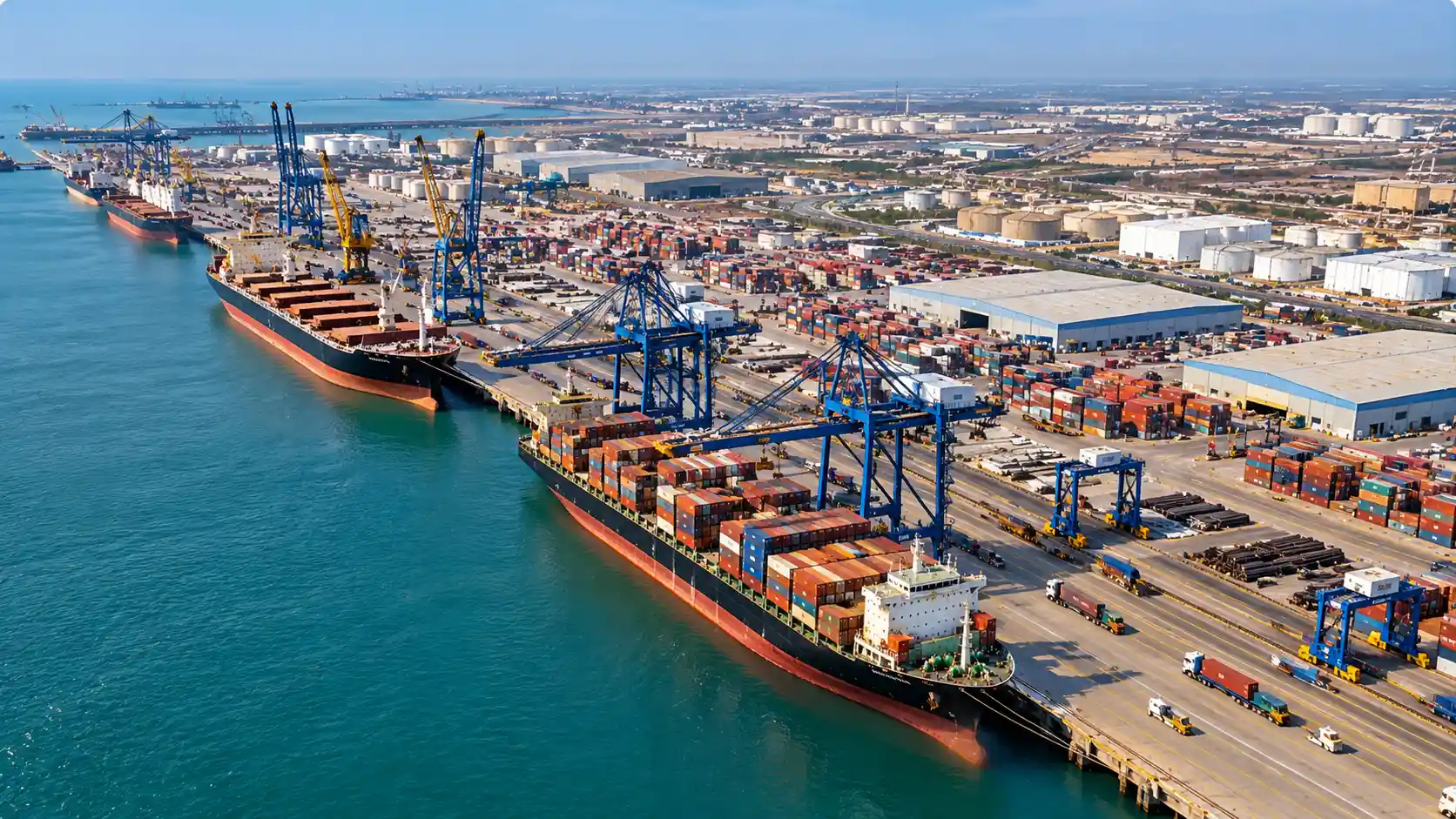
Mundra Port’s infrastructure reflects its scale. The port operates multiple dedicated terminals for containers, dry bulk, liquid cargo, and crude oil, supported by extensive berthing facilities designed for simultaneous vessel handling. According to the same Aranca research report, the port’s operator has environmental clearance for a project that will more than double capacity, rising from about 250 million tonnes per year to 514 million tonnes per year by 2030. The project is estimated to cost about 45,000 crore.
Beyond the berths themselves, Mundra Port’s rail and road connectivity links it directly to industrial clusters across Gujarat and northern India, giving cargo owners fast inland movement once goods clear the port. This combination of berthing capacity and inland logistics is what underpins Mundra’s role as an industrial corridor anchor, not just a coastal facility.
That same scale of infrastructure is why Ship Supply Services at Mundra Port have grown alongside the terminals themselves, vessels berthing across multiple terminal zones need supplies and support that can reach them wherever they’re docked, not just at one fixed jetty.
How Does Mundra Port Support India’s International Trade?
With Indian ports overall handling close to 95% of the country’s trade by volume, ports like Mundra are effectively the physical backbone of India’s import and export economy. Because Mundra Port is so big, it handles a lot of that flow. It handles everything from importing energy and industrial raw materials to sending containers to global markets. For exporters and importers, routing cargo through a facility with Mundra’s berth availability, cargo-handling speed, and multimodal connectivity often translates directly into shorter transit times and more predictable supply chains.
Marine and Vessel Support Services at Mundra Port
Port infrastructure isn’t enough to move cargo; ships that call at Mundra also need reliable help on the water and at the berth. When ships arrive at Mundra, they usually need new food, engine and deck supplies, safety equipment servicing, and technical support. Often, they need this quickly and within a small window of time, because port time costs a lot for ship owners.
A dependable local partner bridges that gap by coordinating supplies, repairs, and compliance checks around the vessel’s actual berthing schedule, rather than making the vessel wait on the supplier.
Why Ship Chandlers Matter for Vessels Calling at Mundra
Every port call at a facility the size of Mundra involves more than loading and discharging cargo. Vessels need Marine Supplies and Vessel Support Services covering provisions, spare parts, underwater hull cleaning, life-saving and fire-fighting equipment servicing, and pre-arrival compliance checks ahead of port state control inspections. Bulk carriers, container ships, tankers, LNG vessels, and offshore supply boats all pass through Mundra, and each vessel type carries its own servicing needs.
Working with an experienced local chandler reduces the operational risk of delays, since equipment, parts, and provisions can be sourced and delivered directly to the berth or anchorage rather than routed through multiple intermediaries.
Conclusion
It’s not by chance that Mundra Port is India’s biggest commercial port. It has deep-draft infrastructure, the ability to handle all types of cargo, strong multimodal connectivity, and ongoing capacity investment that few other Indian ports can match. For vessel operators calling at Mundra, having a dependable marine partner matters just as much as the port’s own scale. Aasutosh Marine supports vessels across Mundra with ship chandling, repairs, and compliance-ready marine supplies, backed by the same standards it maintains as a Ship Chandler in Kandla & All Indian Ports, so wherever your vessel calls next in India, dependable support is already in place.
Frequently Asked Questions
Why is Mundra Port considered one of India’s largest commercial ports?
More than any other Indian port, Mundra Port handled more than 200 million metric tonnes of cargo in FY 2024-25. This was possible thanks to its deep-draft berths, ability to handle all types of cargo, and strong rail and road connections.
Where is Mundra Port located?
Mundra Port is located on the Gulf of Kutch in Gujarat, India, giving it direct access to major East-West global shipping routes.
What types of cargo are handled at Mundra Port?
Mundra Port handles containerised cargo, dry bulk, liquid cargo, crude oil, and break-bulk or project cargo across dedicated terminals.
How does Mundra Port support the maritime supply chain?
As India’s largest commercial port, Mundra absorbs a major share of the roughly 95% of India’s trade that moves by sea, supporting energy imports, industrial raw materials, and containerised exports with fast multimodal connectivity.
How can vessels obtain ship supplies at Mundra Port?
Vessels calling at Mundra can arrange provisions, spare parts, repairs, and safety equipment servicing through an experienced local ship chandler who coordinates delivery directly to berth or anchorage around the vessel’s schedule.